Business systems
ERP and finance records: volumes, orders, invoicing patterns and how the business has actually been performing.
The platform
Northra sits above the systems you already run. It reads what they hold, works out what has shifted since last week, and takes that as far as a recommendation someone can act on. You can see how it got there at every step.
Decision layerThree stages
You already have the reports. What you do not have is the half day someone spends turning them into a decision.
Stage one
Northra reads the systems your teams work in every day, along with the documents and market feeds around them. Nobody moves to a new tool and nothing has to be migrated first.
ERP and finance records: volumes, orders, invoicing patterns and how the business has actually been performing.
Pipeline, quotes, account history, service events, and the commercial context sitting around all of it.
Price and index movement, demand indicators, what competitors are doing, and events on the supply side.
How your contracts are structured, where the margin sits, and which parts of the book move when an input moves.
Reports, decks, technical files, specifications and the reasoning behind decisions the company already took.
Product and application knowledge, plus the compliance picture and the constraints it puts on you.
Stage two
This is the part that normally costs an analyst half a day. Northra takes what moved, finds the parts of your business it touches, and sets out what follows from it.
A feedstock moves. So does an index, or a customer's ordering pattern, or a competitor announces capacity, or a regulator shifts position.
Which products, grades, contracts, regions and accounts does this actually touch? That answer comes out of your own data rather than a general model.
What it does to margin, to supply, to risk, and to where you stand with the customer. Written in the language your commercial team already speaks.
Not every change is worth a meeting. Northra puts the ones that are at the top, and tells you why they made the cut.
Stage three
The work only counts once it becomes a pricing response, an account to call, a supply mitigation, or a briefing that leadership can use. The reasoning travels with it.
Pricing moves and customer conversations, prepared by someone who already knows the exposure.
Which accounts to work this month, and the specific thing to raise with each one.
Portfolio, segment and regional moves, with the evidence for each already assembled.
Executive briefings that lead with the decision and keep the evidence one click behind it.
Governance
In this industry a decision carries commercial and contractual weight, so the model drafts the interpretation and the reasoning behind it, and whoever owns the decision approves it. Every recommendation keeps its sources, its working and its approval trail, which means you can still explain the call eight months later to a customer, an auditor or the board.
A day on the layer
These are real screens from the demo workspace, running on synthetic data shaped like a chemical producer's. Follow them in order and you get the same morning your pricing team already has.
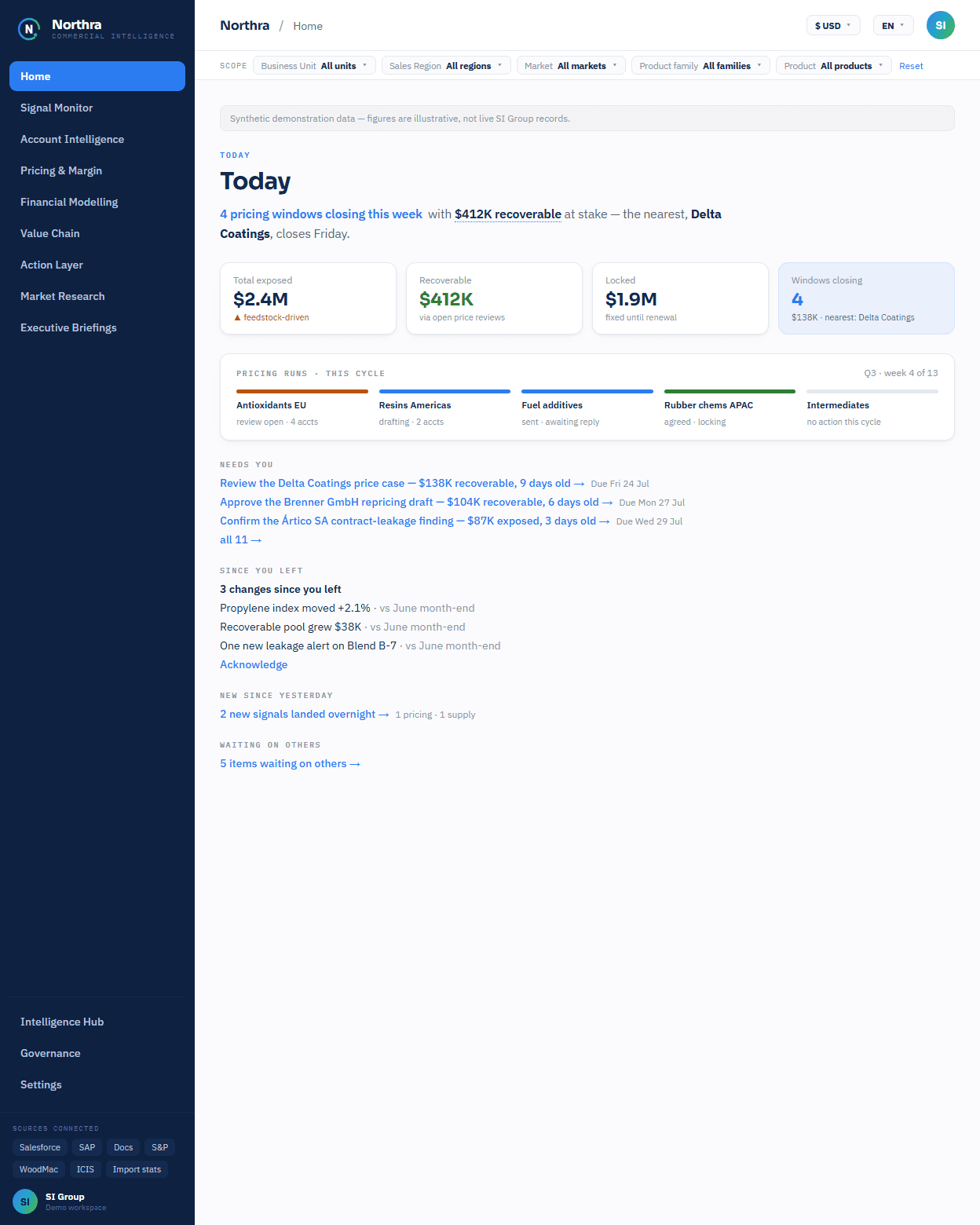
One sentence tells you four pricing windows close this week, how much is recoverable across them, and which deadline lands first. Every figure opens into the evidence underneath it.
So nobody spends the first hour reconciling exports.
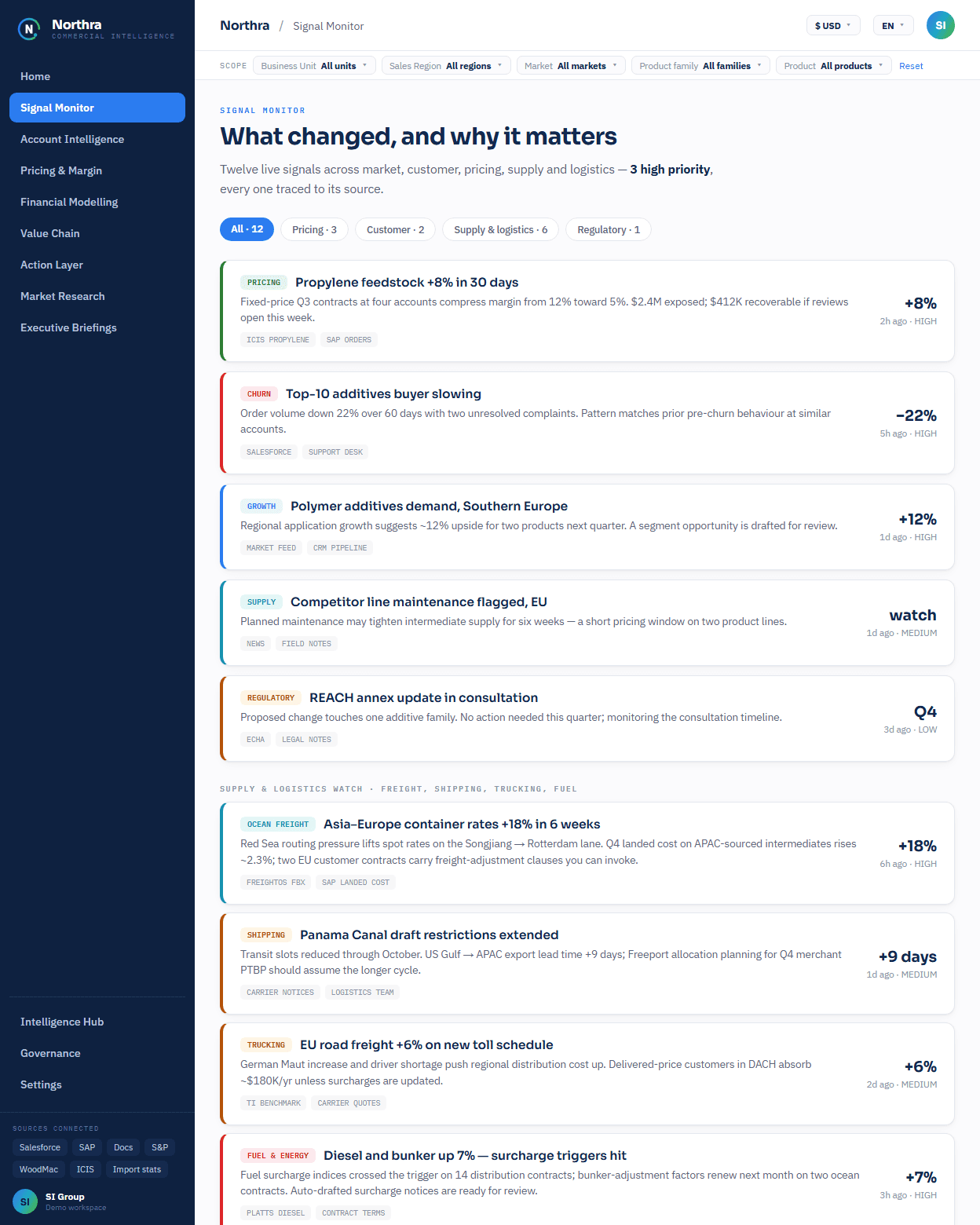
Market, customer, pricing, supply and logistics signals land in one stream. Each carries its source, and they are ordered by what they are worth to you rather than by when they arrived.
Picking these up takes hours instead of weeks, while the window is still open.
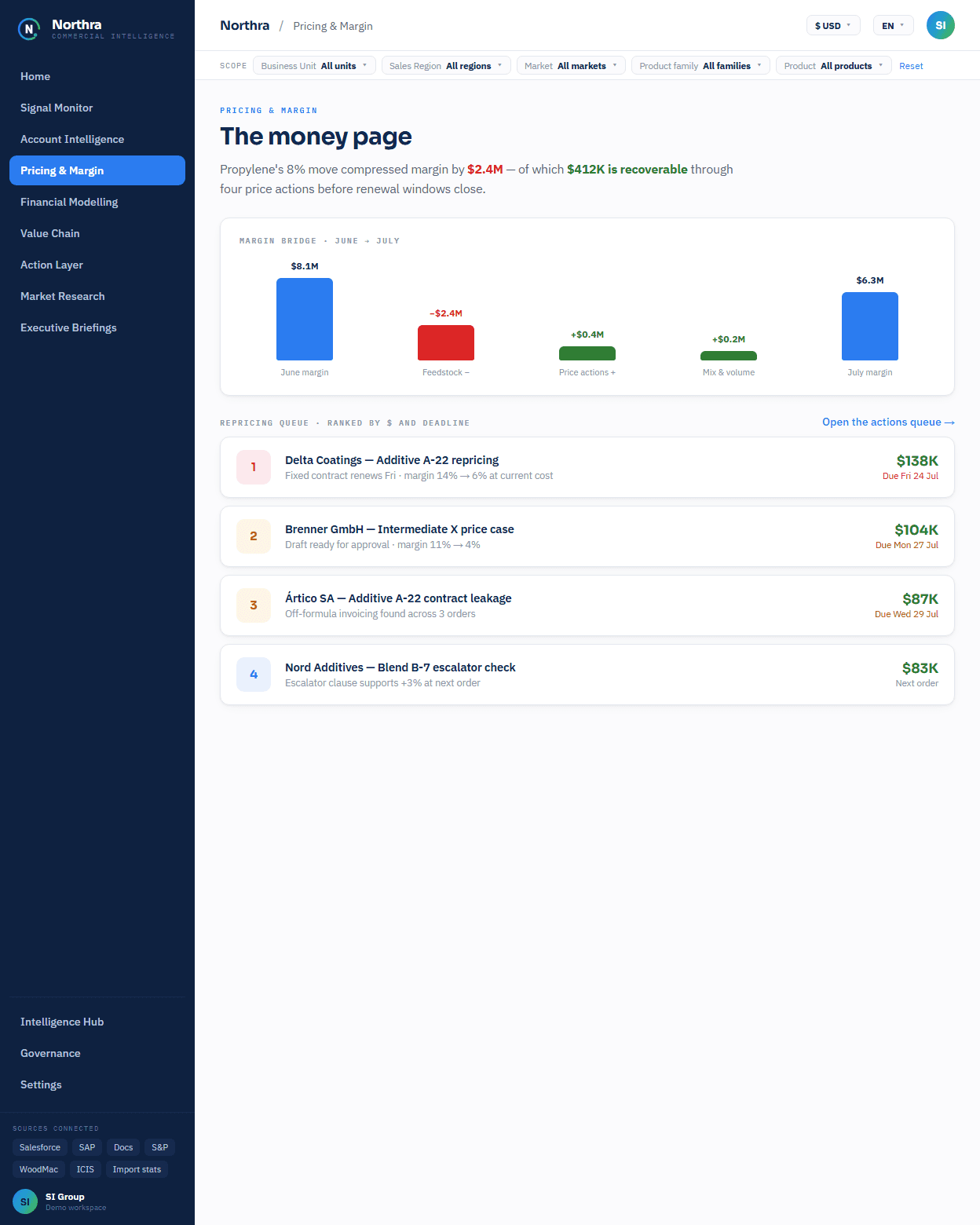
The bridge shows what feedstock took out of the margin. The queue below it ranks recovery by money and deadline, and each row already knows whether the contract clause supports the move.
The pricing conversation starts from evidence rather than instinct.
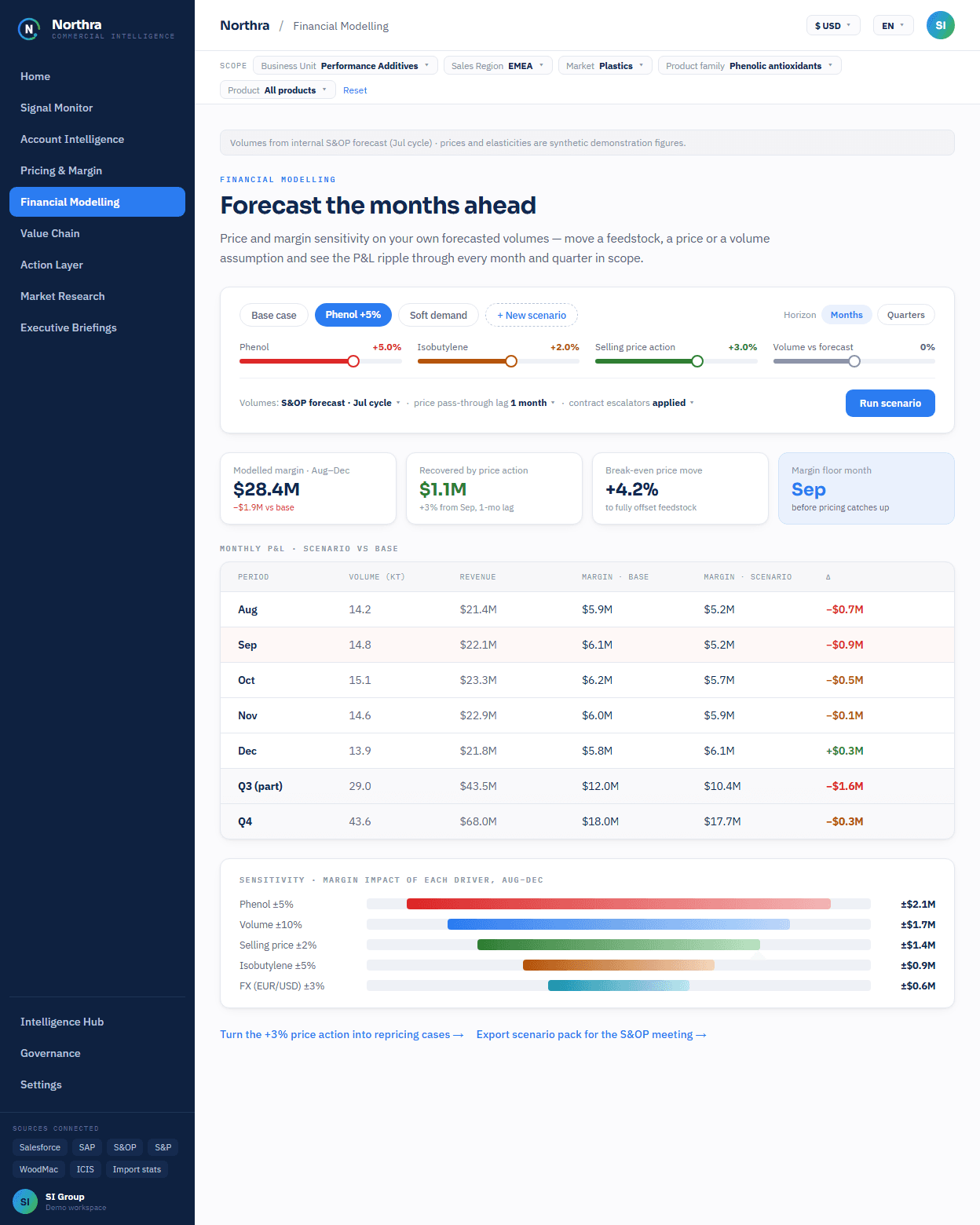
Scenarios run against your own planned volumes rather than a generic curve, and come back with break-even, the margin floor, and the quarter it lands in.
Finance and commercial end up arguing from the same number.
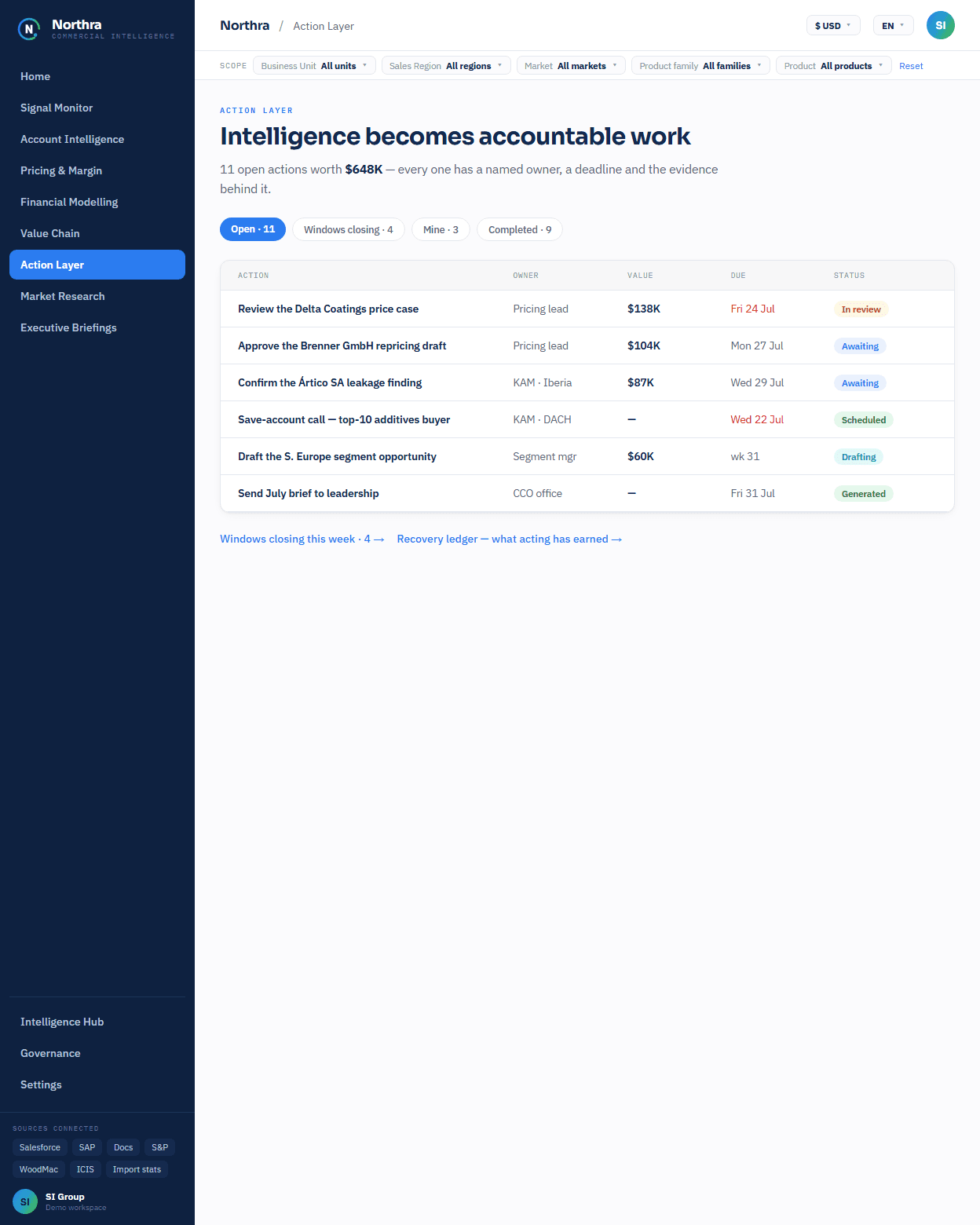
Open actions carry an owner, a deadline and the evidence one click away. A return loop records what acting on them actually earned.
You can trace a line from the original signal to the margin you recovered.
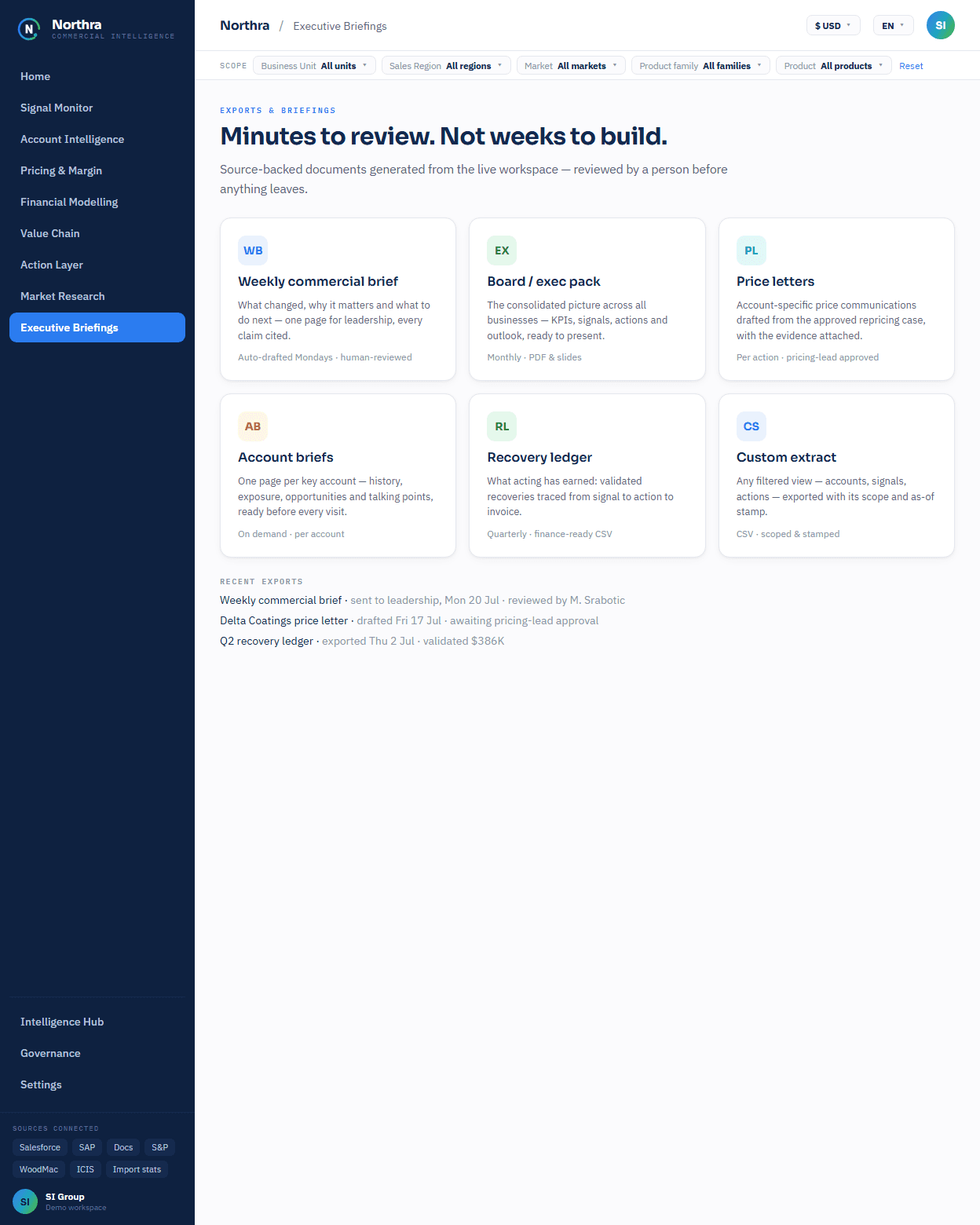
One page, sourced and reviewed by a person, assembled from the same evidence the team acted on rather than rebuilt by hand on Friday afternoon.
Senior time goes back to judgement.
Where it sits
Northra connects to the enterprise stack rather than competing with it. Your systems of record stay exactly where they are and the decision layer sits on top of them.
Next step
The most useful evaluation we can offer is a question your team currently answers slowly, taken from the first signal to a recommended action while you watch.